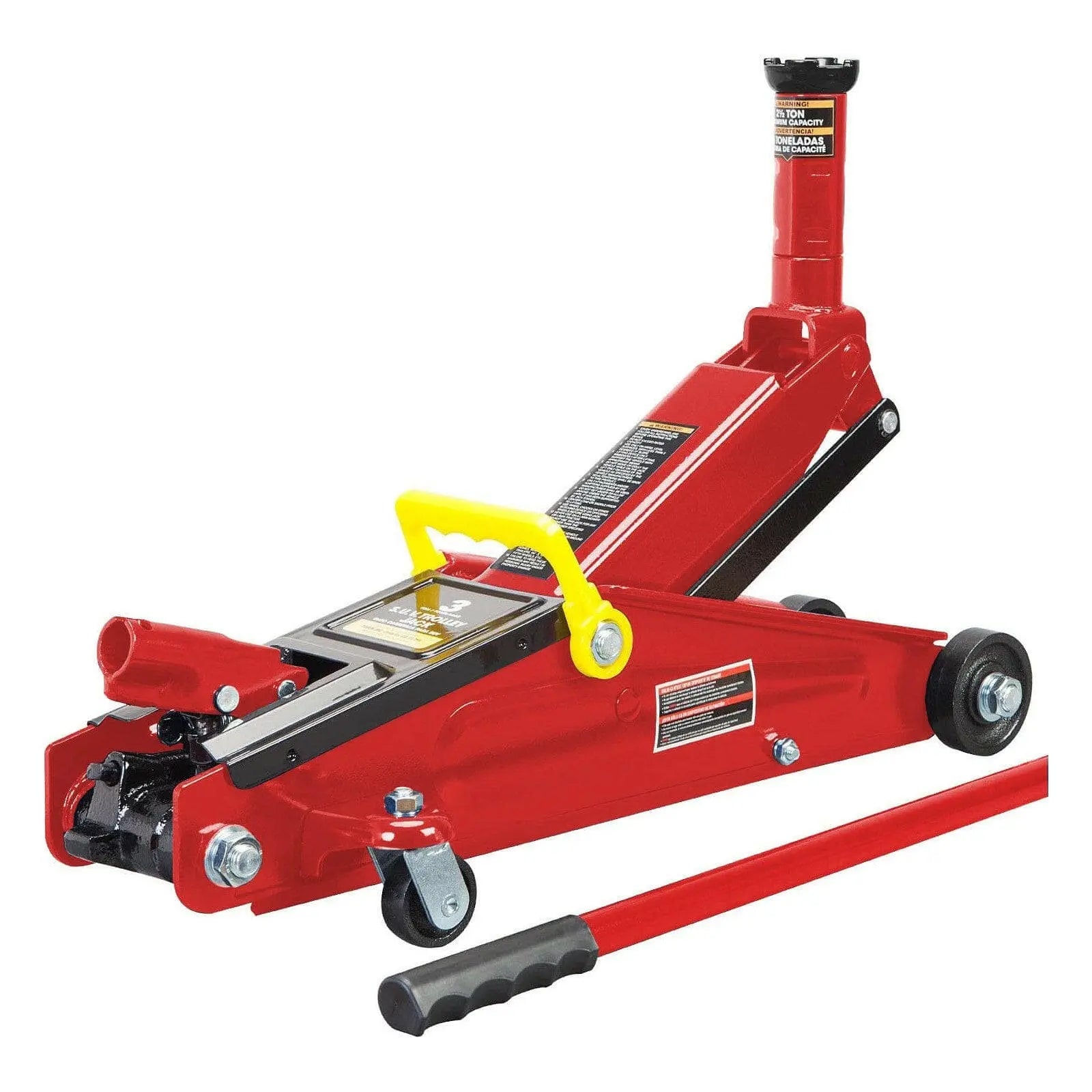
Hydraulic Floor Jacks Compared: Capacity, Reach, Weight
We compared capacity, lift range, and ASME safety documentation across five hydraulic floor jacks, from a 2-ton low-profile lift to a 3.5-ton pro double-pumper.
Quick answer
Across the five jacks we researched, the AFF 350SS stands out for buyers who need real margin above their vehicle's weight: it's rated to 3.5 tons, uses a double-pump system for faster lifting, and is the only jack here whose manufacturer explicitly documents ASME/PALD safety compliance on its own spec page. That extra capacity and documentation come at a cost, though; at 119 lbs it's the heaviest jack in this group and its 4 inch minimum height rules it out for lowered cars. If low clearance matters more than raw capacity, the Daytona Super Duty is the stronger pick, with a 3-3/4 inch starting height, a taller 23-1/8 inch max, and a dual-pump system Daytona says needs only about 4.5 strokes to reach full height. For anyone who mainly lifts a sedan or compact crossover and wants the lightest, cheapest option to own, the 2-ton Pro-Lift F-767 is a reasonable tradeoff of capacity for real savings in weight and price. Note that the AFF 350SS is a substitution for the Hein-Werner HW93642 originally on our candidate list, which we could not verify as an active Amazon.com listing.
Updated September 2026Advertising DisclosureTop Relevant
✓Carefully researchedProduct data reviewed
◇Independent picksClear comparison criteria
▣Practical resultsBuilt around real use cases
$Price & valueFeatures compared clearly
Buyer checklist
How We Compared These Best Hydraulic Floor Jacks for Home and Pro Garages
We compared published specifications, capacity, lift range, weight, pump technology, and stated safety certification, pulled directly from each manufacturer's own product pages, then cross-checked against the exact Amazon listing tied to each product's ASIN and, where available, independent retailer spec sheets. We did not physically test or lift a vehicle with any of these jacks; where manufacturer and retailer sources disagreed, as they did on the Torin's maximum lift height and reported weight, we noted the discrepancy rather than silently picking one figure.
Best Hydraulic Floor Jacks for Home and Pro Garages Buying Questions
Is it ever safe to work under a car that's supported only by a floor jack?
No. Every hydraulic floor jack, including all five in this guide, is a lifting device, not a support device. Manufacturers across this category, including Daytona, Arcan, Torin, Pro-Lift, and AFF, build in safety and overload valves to prevent the jack itself from failing, but none of that replaces jack stands rated for your vehicle's weight. Raise the vehicle, then set it down onto stands positioned at the manufacturer-specified support points before anyone goes underneath.
What does ASME PALD (or ASME PASE) certification actually mean?
ASME PALD, Portable Automotive Lifting Devices, was the long-standing safety standard covering load rating accuracy, structural strength, and labeling requirements for jacks like these; it was reorganized under the newer ASME PASE name in the early 2010s, and both cover the same equipment category. AFF's 350SS cites 2009 ASME/PALD compliance on its own spec page, and other jacks in this category reference the newer PASE standard, but the certification doesn't test how you use the jack, so it's not a substitute for using jack stands underneath.
Does a low-profile jack sacrifice weight capacity or lift height compared to a standard jack?
Often, yes, though it's not a universal rule. In this lineup, the lowest-clearance jack, the Pro-Lift F-767 at 3-1/2 inches minimum height, is also the lowest-capacity one at 2 tons and has the shortest 14 inch maximum height. The Daytona Super Duty shows it doesn't have to be that way, with a comparably low 3-3/4 inch starting height, a full 3-ton capacity, and a taller 23-1/8 inch maximum, so it's worth comparing the full spec sheet rather than assuming low-profile automatically means less capable.