Buyer checklist
How We Compared These Camera Lens Cleaning: 5 Tools and the Order You Should Use Them In
Sourcing first, because it is weaker here than it would be for a camera body and you should know that. Every ASIN and listing title below was pulled from the live Amazon.com listing. For the Giottos blower we used B&H Photo's published specification table, which carries the manufacturer figures. For the other four, accessory brands in this category mostly do not maintain public spec sheets, LensPen's own product URL for the NLP-1 currently returns a 404 and K&F Concept's site refused our requests, so the figures come from manufacturer copy as carried by retailer listings. We have said which is which inside each product section rather than presenting all five as equally well sourced. Nothing here was tested by us, no lens was cleaned, no coating was scratched, and no durability claim is ours. What we did spend the time on instead is variant disambiguation, because this category is full of near-identical SKUs: we traced the Zeiss wipe count and alcohol strength across separate ASINs, and found that the K&F filter ASIN here has carried listing titles citing both an 18-layer and a 28-layer coating at different times. Those findings are in the checks, not buried.
Camera Lens Cleaning: 5 Tools and the Order You Should Use Them In Buying Questions
What is the correct order to clean a camera lens?
Air, then dry, then wet, and only as far down that list as the dirt requires. Blow loose dust off first with a blower like the Giottos AA1900, which draws air through a one-way valve at the base so it is not firing the dust it just collected back at the glass. If marks remain, use a dry tool such as the LensPen's carbon tip. Only use a pre-moistened wipe for fingerprints or oily residue that a dry tool would spread. The reason the order is not optional: a cloth pressed onto dry grit becomes an abrasive, and lens coatings are what you damage, not the glass underneath.
Do UV filters actually protect a lens, or do they just degrade the image?
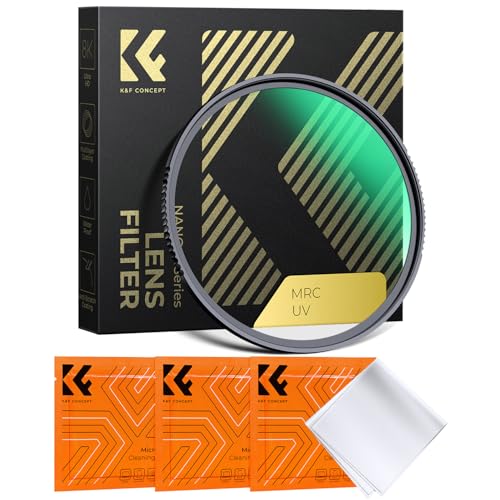
Both claims have some truth and we are not going to pretend this is settled. A flat piece of coated glass in front of the front element takes the scratches, dust and fingerprints instead of the lens, and it is far cheaper to replace. The cost is one more air-to-glass surface, which is what coating quality is for, K&F publishes 94% light transmission for its 18-layer K-Series coating and 99.6% for the 28-layer Nano-X, a gap wide enough to matter if you shoot into light sources. A cheap uncoated filter is a genuinely bad idea, a well-coated one is a reasonable trade, and the honest answer depends on which one you buy.
Are eyeglass wipes safe on camera lenses?
Zeiss sells these as pre-moistened lens cleaning wipes and states they are non-abrasive, ammonia-free, lint-free and safe for anti-reflective coatings, which is the same class of coating camera lenses carry, and photographers use them widely for exactly that reason. Two cautions. The coating-safety claim is Zeiss's own, not an independent test result. And alcohol strength is not consistent across the range, the standard wipes are described at roughly 40 to 50% isopropyl alcohol while a separate line is sold at 70%, on different ASINs. If you care which is going on your glass, read the listing you are actually buying.