 Product image from current catalog data
Product overview
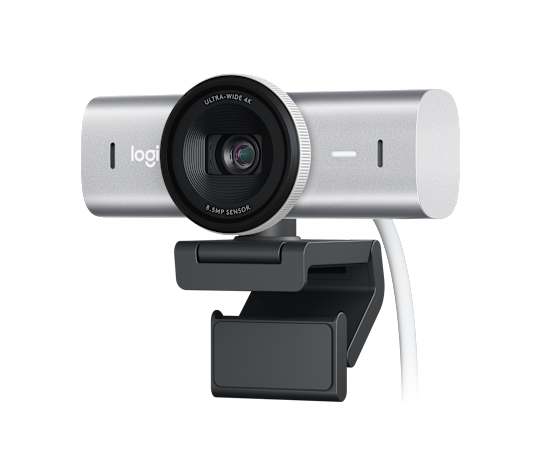
Logitech MX Brio: What to Know
Logitech's spec sheet for the MX Brio lists a Sony STARVIS sensor (model IMX415, 1/2.8-inch) with 1.45-micrometer pixels, a 90-degree diagonal field of view, and dual beamforming microphones tuned to cut background noise. Maximum output is 4K at 30fps or 1080p at 60fps over USB-C, the classic tradeoff on nearly every high-resolution webcam, since higher resolution and higher frame rate compete for the same USB bandwidth, not a flaw unique to this model.
What separates the MX Brio from a generic 4K webcam is the software layer. Logitech's RightSight auto-framing keeps you centered as you move, and the camera uses closed-loop autofocus that Logitech and independent reviewers describe as fast to reacquire a face after you shift position, a genuinely useful trait for anyone who talks with their hands or leans back in a chair mid-call.
Logitech markets 'AI-enhanced image quality' and improved low-light handling versus the older Brio 4K, citing larger pixels for better light gathering. That's a real, physical spec difference (bigger pixels do collect more light), but exactly how much better a room looks under your specific lighting is not something we can verify from a spec sheet, treat it as a plausible improvement, not a guaranteed result.
A built-in privacy shutter, a detachable USB-C cable, and a tripod-compatible mount round out the hardware, and Logi Tune software exposes manual controls (zoom, pan, tilt, HDR toggle) if you want more control than the defaults.
Key Listed Features
Sony STARVIS 1/2.8-inch sensor with 1.45μm pixels
4K at 30fps or 1080p at 60fps, 90-degree diagonal FOV
Closed-loop autofocus with RightSight auto-framing
Dual beamforming mics, USB-C, built-in privacy shutter