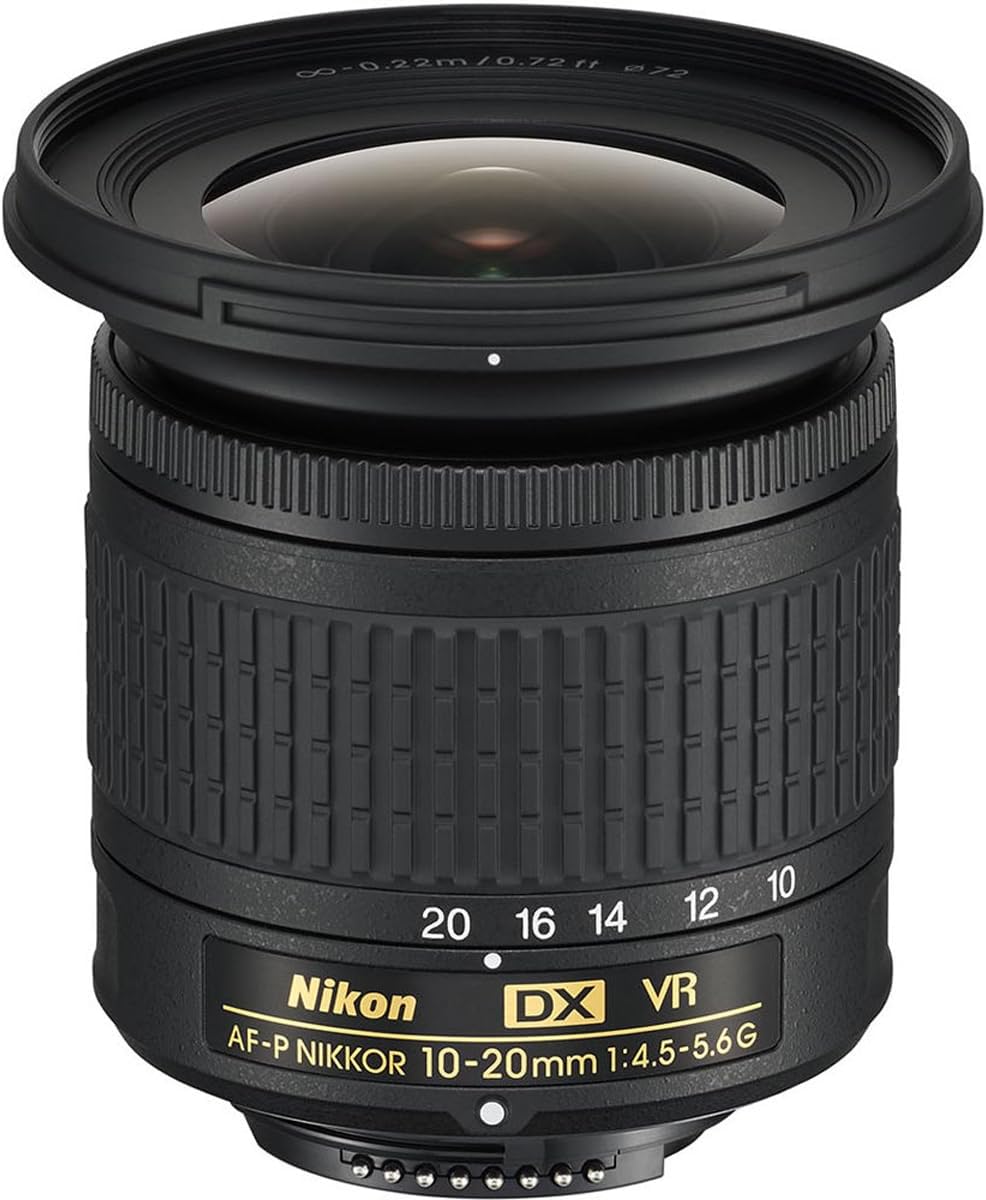
 Product image from current catalog data
Product overview
Nikon AF-P DX NIKKOR 10-20mm f/4.5-5.6G VR: What to Know
This is the cheapest genuine ultra-wide Nikon makes for DX bodies, and Nikon's framing of it is accurate rather than boastful: an ultra-wide view that surpasses any kit lens. The numbers behind that are a picture angle running from 109 degrees at 10mm down to 70 degrees at 20mm, which on a DX body is roughly a 15 to 30mm full-frame equivalent framing. One hundred and nine degrees is wide enough to change how you compose rather than simply fitting more in.
Two specifications make it more usable than ultra-wides normally are. There is vibration reduction, which ultra-wides at this price usually omit and which matters because ultra-wide work means dim interiors and night scenes at f/4.5. And the minimum focus distance is 0.22 metres, 0.8 feet, measured from the focal plane, which means you can almost touch a foreground subject while keeping a whole landscape behind it, the composition the focal length exists for.
Autofocus is a near-silent stepping motor that Nikon positions as ideal for recording video, which is the AF-P advantage: on a vlogging or walkthrough shot with a wide lens, focus motor noise reaching the built-in microphone is a real problem and this design is quiet. It accepts screw-on filters, which is worth noting because many ultra-wides have bulbous front elements that cannot take them.
The caveat is the same one as the 70-300 above and it is not optional. This is an AF-P lens, so the body compatibility lists apply: a long list of older Nikon DSLRs cannot use it at all, and some others have limited function. Check your specific model against Nikon's lists before ordering. It is also DX, so it crops on an FX body.
Key Listed Features
10 to 20mm on DX with a picture angle from 109 degrees down to 70 degrees
Vibration reduction, unusual on an ultra-wide in this price class
Minimum focus distance of 0.22 m (0.8 ft) from the focal plane
Near-silent AF-P stepping motor, specified by Nikon for video, and accepts screw-on filters


