Buyer checklist
How We Compared These Board Games for 2 to 5 Year Olds: The Stated Minimum Age Is the Whole Specification
Every age, player count and component list below is the publisher's own stated figure, read off the live Amazon.com listing including the detail tables, and we have named the publisher in each case: HABA, Educational Insights and Peaceable Kingdom. At this age range the stated minimum age is the most consequential specification a game has, so we checked it in both places each listing states it, the feature bullets and the manufacturer recommended age field, and found one direct contradiction, which is reported in that product's section rather than averaged away. We also recorded what is physically in each box, because at two and three years old the components are the game: a wooden piece a toddler can grip is a different product from a cardboard token. We did not play these with children, time a session or assess any developmental claim, and the skills each publisher attributes to its game are their claims rather than measured outcomes. Award citations are quoted as the publisher states them.
Board Games for 2 to 5 Year Olds: The Stated Minimum Age Is the Whole Specification Buying Questions
Can a two-year-old really play a board game?
A cooperative one with wooden pieces and almost no rules, yes. What a two-year-old can do is take a turn, follow one instruction and put a piece somewhere, and HABA's First Orchard is built around exactly that, with a manufacturer recommended age of 24 months to 3 years. What they cannot do is lose gracefully, wait through three other players, or hold a strategy, which is why the game is cooperative and why nothing on this page below three years old is competitive. The realistic expectation is a five-minute shared activity rather than a game night.
Cooperative or competitive at this age?
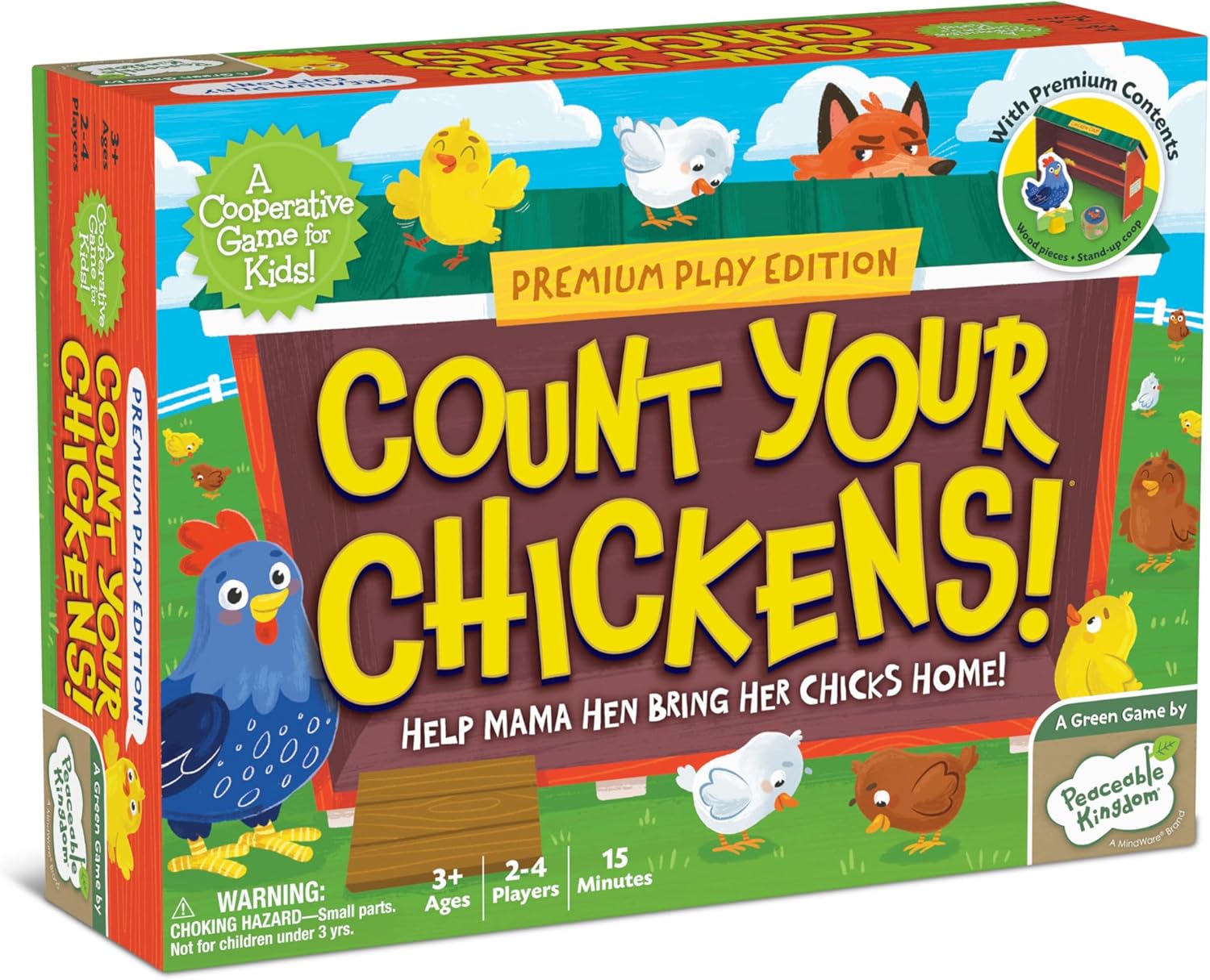
Cooperative until roughly four, and it is not a close call. Two of the four games here are explicitly cooperative, First Orchard and Count Your Chickens, and both publishers give the same reason: it removes the competitive pressure that ends a session in tears. A three-year-old losing to a five-year-old sibling is the most reliable way to make a game unpopular. Competitive play starts working once a child can understand that losing a game is not a verdict on them, which for most children is somewhere around four or five, which is where Monza sits.
Why do stated ages differ so much between listings?
Because they are publisher recommendations rather than a tested standard, and publishers weigh different things: component size and choking risk, reading requirement, rules complexity, attention span and, less honestly, marketability. That is why you will see the same game listed at 3 and up in one place and 6 and up in another, which is exactly what happens on the Count Your Chickens listing in this guide. The practical approach is to read the component list and the mechanic rather than trusting the number: a game needing counting to ten needs a child who can count to ten, whatever the box says.